Beginner kettlebell workout
Eight essential kettlebell moves for beginners, with form cues, how to pick your weight, and a 20-minute full-body routine you can do with one kettlebell.
Why it works
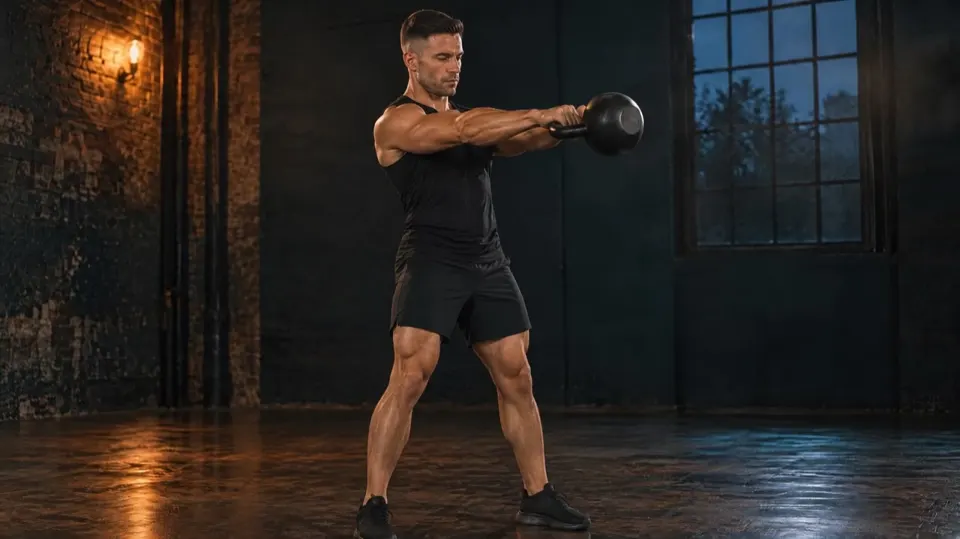
One kettlebell trains your whole body. Its offset handle challenges your grip and core on every rep, and moves like the swing build strength and raise your heart rate at the same time.
This guide starts with slow strength moves to groove good form, then introduces the swing, the signature kettlebell exercise.
Safety first
- Clear the space around you and train on a non-slip floor.
- Hinge from your hips with a flat back when you pick the kettlebell up or put it down.
- Learn the deadlift before the swing. Never let the swing pull your lower back round.
- Start lighter than you think. Many beginners start with 6–8 kg, and stronger beginners with 12 kg.
- Stop if you feel sharp pain, especially in your lower back or shoulders.
The 8 exercises
- 1
Kettlebell deadlift
Glutes, hamstrings & back- Stand with feet hip-width apart, kettlebell on the floor between your feet.
- Push your hips back and bend your knees slightly, flat back, and grip the handle.
- Stand up by driving through your feet and squeezing your glutes. Lower with the same hinge.
- How much
- 3 sets of 8–10
- Easier
- Raise the bell on a step so you hinge less far.
- Harder
- Pause for 2 seconds at the bottom without letting go.
- 2
Goblet squat
Legs & core- Hold the kettlebell by the horns at your chest, elbows pointing down.
- Sit down between your heels, keeping your chest tall.
- Stand up by pushing through your whole foot.
- How much
- 3 sets of 8–10
- Easier
- Squat to a chair behind you.
- Harder
- Pause at the bottom for 2 seconds.
- 3
Two-hand swing
Glutes, hamstrings & cardio- Set up as for the deadlift with the bell a foot in front of you.
- Hike it back between your thighs, then snap your hips forward so the bell floats to chest height.
- Let it fall back, hinge to catch it, and repeat. Your arms guide, your hips do the work.
- How much
- 5 sets of 10–15
- Easier
- Do deadlifts until the hinge feels natural.
- Harder
- Do sets of 20, or try single-arm swings.
- 4
Single-arm row
Upper back & arms- Stagger your stance and rest one hand on a chair or your front thigh.
- Pull the kettlebell towards your hip, keeping your elbow close.
- Lower slowly. Do all reps on one side, then switch.
- How much
- 3 sets of 8–10 each side
- Easier
- Use a lighter bell or more support.
- Harder
- Pause for a second at the top of each row.
- 5
Halo
Shoulders & core- Hold the kettlebell upside down by the horns at chest height.
- Circle it slowly around your head, close to your head, keeping your ribs down.
- Change direction each set.
- How much
- 3 sets of 5 each direction
- Easier
- Use a lighter bell or make smaller circles.
- Harder
- Do it in a half-kneeling position.
- 6
Single-arm press
Shoulders & triceps- Hold the bell at your shoulder in the rack position, wrist straight.
- Squeeze your glutes and press it overhead until your arm is straight.
- Lower it back to your shoulder with control.
- How much
- 3 sets of 5–8 each side
- Easier
- Press from a seated position or use a lighter bell.
- Harder
- Press from half-kneeling.
- 7
Goblet reverse lunge
Legs & balance- Hold the bell at your chest.
- Step one foot back and lower until both knees are bent at about 90 degrees.
- Push through your front foot to stand. Alternate legs.
- How much
- 3 sets of 6–8 each leg
- Easier
- Do it without weight, holding a chair.
- Harder
- Do all reps on one leg before switching.
- 8
Suitcase carry
Grip, core & posture- Pick up the kettlebell in one hand like a suitcase.
- Walk tall for 20–30 metres, or around the room, without leaning.
- Switch hands and repeat.
- How much
- 3 carries each side
- Easier
- Use a lighter bell or a shorter distance.
- Harder
- Use a heavier bell or walk more slowly.
The routine
Rest 45–60 seconds between sets. Keep every rep smooth, and stop a set when your form slips.
| Part | Exercises | Time |
|---|---|---|
| Warm-up | Halo, bodyweight squats, hip hinges | 4 min |
| Strength | Deadlift, goblet squat, single-arm row, single-arm press | 9 min |
| Power | Two-hand swings: 5 rounds of 10–15 | 4 min |
| Finisher | Goblet reverse lunge, suitcase carry | 3 min |
How often
Two or three kettlebell sessions a week, with a day off between them, is plenty for beginners.
When you can do every set with clean form, add a few reps. When the top of the rep range feels easy, move up to a heavier bell.
Want a plan that does this for you?
Train at Home includes Kettlebell Basics, a beginner kettlebell plan, a 14-minute Kettlebell Express, Full Body Kettlebell and Kettlebell Strength & Power, with every move shown by a real trainer.
Coming soon to theApp StoreFrequently asked questions
What weight kettlebell should a beginner use?
Many beginners start around 6–8 kg, and stronger beginners around 12 kg. Pick a weight you can deadlift and goblet squat for 10 clean reps. You will usually need a heavier bell for swings and deadlifts than for presses.
Can you get fit with just one kettlebell?
Yes. One kettlebell covers squats, hinges, rows, presses, carries and swings, which together train your whole body.
Are kettlebell swings bad for your back?
Done with a proper hip hinge and a flat back, swings strengthen the back and glutes. Learn the deadlift first and stop if you feel pain.
How long should a kettlebell workout be?
Fifteen to thirty minutes is enough for most people, especially when the session includes swings.
Sources
This guide is general information, not medical advice. Talk to your doctor or a physiotherapist before starting a new exercise programme, especially if you have a health condition.